
Handbook
FastAPI Handbook
From ASGI and Pydantic to auth, async databases, queues, production and architecture — six volumes, 135 pages, every snippet run.
- 6
- volumes
- 135
- pages
- 129
- page topics
- A4
- print-ready
- Who it is for
- Backend engineers from first API to senior system design — learners, Flask / Django switchers and interview candidates.
- Each page has
- a diagram, code that was actually run, tables, production rules, common mistakes and interview questions.
- Format
- A4 notebook pages. Read them in the browser, print them or save as PDF.
- Updates
- Lifetime access. New and revised volumes appear in your library free.
01The volumes
Buy them together, or one at a time.
Each volume stands on its own. The handbook price covers all of them, and any volume added later.
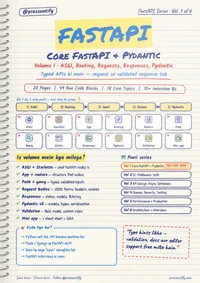
Volume 1 · 20 pages
Core FastAPI & Pydantic
ASGI and Starlette, routing, path, query and body parameters, responses and response models, Pydantic v2 models, validation and a tested mini app.
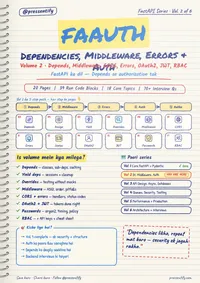
Volume 2 · 20 pages
Dependencies, Middleware, Errors & Auth
Depends and yield dependencies, overrides, middleware and CORS, error handling, OAuth2, JWT, password security, RBAC and API keys.
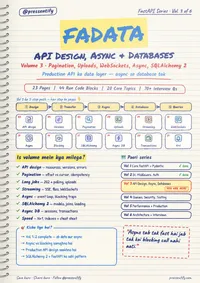
Volume 3 · 23 pages
API Design, Async & Databases
Pagination, idempotency, long jobs, uploads, streaming, WebSockets, lifespan, async and blocking calls, SQLAlchemy 2, transactions and N+1.
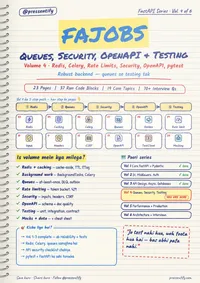
Volume 4 · 23 pages
Queues, Security, OpenAPI & Testing
Redis and caching, Celery, queues and the outbox, rate limiting, input security, CSRF, OpenAPI, and unit, integration and contract testing.
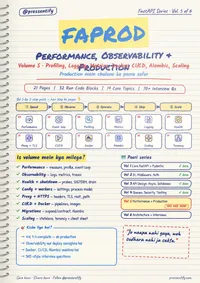
Volume 5 · 21 pages
Performance, Observability & Production
Profiling and the event loop, logging, metrics, health checks, graceful shutdown, config, Docker, CI/CD, Alembic, scaling and multi-tenancy.
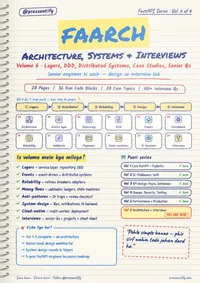
Volume 6 · 28 pages
Architecture, Systems & Interviews
Service layer, DDD, distributed systems, reliability patterns, webhooks, payments, anti-patterns, code review, case studies and senior interview questions.
02What is inside
Every page, by topic.
129 page topics across 6 volumes, taken from the books' own page titles.
Vol 1 · Core FastAPI & Pydantic20 pages · 19 topics
- 01How to use this book
- 02FastAPI at a glance
- 03ASGI
- 04Starlette
- 05App creation & config
- 06Routing
- 07APIRouter
- 08Path parameters
- 09Query parameters
- 10Request bodies
- 11Headers, cookies, forms
- 12Response handling
- 13Response models
- 14Pydantic I
- 15Pydantic II
- 16Data modeling
- 17Validation
- 18Mini app
- 19Vol 1 Cheat Sheet
Vol 2 · Dependencies, Middleware, Errors & Auth20 pages · 19 topics
- 01How to use this book
- 02Dependency injection
- 03Dependency design
- 04Yield dependencies
- 05Dependency overrides
- 06Request context
- 07Middleware I
- 08Middleware II
- 09CORS
- 10Exception handling
- 11Status codes
- 12Authentication
- 13OAuth2
- 14JWT
- 15Password security
- 16Authorization
- 17API keys & service auth
- 18Mini app
- 19Vol 2 Cheat Sheet
Vol 3 · API Design, Async & Databases23 pages · 22 topics
- 01How to use this book
- 02API design
- 03API versioning
- 04Pagination
- 05Idempotency
- 06Long-running operations
- 07File uploads
- 08Streaming responses
- 09WebSockets
- 10Lifespan
- 11External HTTP clients
- 12Async programming
- 13Blocking calls
- 14Concurrency & parallelism
- 15Database integration
- 16SQLAlchemy 2 I
- 17SQLAlchemy 2 II
- 18Async SQLAlchemy
- 19Transactions
- 20ORM query optimisation
- 21Mini app
- 22Vol 3 Cheat Sheet
Vol 4 · Queues, Security, OpenAPI & Testing23 pages · 22 topics
- 01How to use this book
- 02Redis
- 03Caching
- 04Background tasks
- 05Celery & job queues
- 06Message queues & events
- 07Transaction + queue consistency
- 08API rate limiting
- 09Input security
- 10API security headers
- 11CSRF
- 12OpenAPI
- 13API documentation quality
- 14Testing with TestClient
- 15Async testing
- 16Unit testing
- 17Integration testing
- 18Contract testing
- 19Mocking
- 20Test data
- 21Mini app
- 22Vol 4 Cheat Sheet
Vol 5 · Performance, Observability & Production21 pages · 20 topics
- 01How to use this book
- 02Performance engineering
- 03FastAPI performance
- 04Event loop performance
- 05Profiling
- 06Observability
- 07Logging
- 08Health checks
- 09Graceful shutdown
- 10Application configuration
- 11Production process model
- 12Reverse proxy & HTTPS
- 13CI/CD
- 14Docker
- 15Database migrations
- 16Alembic
- 17Horizontal scaling
- 18Multi-tenancy
- 19Mini app
- 20Vol 5 Cheat Sheet
Vol 6 · Architecture, Systems & Interviews28 pages · 27 topics
- 01How to use this book
- 02Architecture styles
- 03Service layer
- 04Repository pattern
- 05Domain-driven design
- 06Event-driven architecture
- 07Distributed systems I
- 08Distributed systems II
- 09Reliability patterns
- 10External integrations
- 11Webhooks
- 12Payments & ledgers
- 13API state machines
- 14Anti-patterns I
- 15Anti-patterns II
- 16Code review I
- 17Code review II
- 18System design: E-commerce API
- 19System design: file processing
- 20System design: notifications
- 21System design: AI backend
- 22Multi-worker & cloud-native
- 23Senior Qs I
- 24Senior Qs II
- 25Priority map & projects
- 26Production debugging
- 27Series Cheat Sheet
03Around it
Learn it, look it up, then keep the handbook.
The same subject is on the site as a course and a cheatsheet. The handbook is the printable version for revision.
- System Design HandbookHLD, LLD, case studies and interview prep, end to end — seven volumes, 170 pages.
- AWS Production HandbookRunning real workloads on AWS — one page per service, plus a second volume on EKS, events, identity, data and AI.
- Python HandbookPure Python from core language and OOP to internals, concurrency, data and AI — four volumes for freshers to 5-year engineers.
- AI Full-Stack HandbookML foundations, LLMs and RAG, agents, inference, evaluation, security, MLOps and AI system design — seven volumes, 153 pages.
- Django HandbookDjango from request lifecycle to production architecture — ORM and PostgreSQL, auth and DRF, async and Celery, operations, design and interviews. Six volumes, 143 pages, every snippet executed.
?Questions
Before you start
- What exactly do I get?
- Access to the handbook in your library: every page, readable in the browser and printable as PDF. You pay once; there is no subscription.
- Can I read before I buy?
- Yes. Every volume has free sample pages. Sign in with a free account, open any volume, and the first pages are yours to read.
- Will I get updates?
- Yes. When a volume is revised, or a new volume is added to a handbook you own, it appears in your library at no cost.
- How do I pay?
- UPI, cards and netbanking through Razorpay. You enter an email; sign in with it to read.
- Refunds?
- Digital goods are not refundable once the full book is opened. If a file is broken or not as described, write to us within 7 days and we will fix it or refund you.
Read a few pages first.
Sample pages are free with an account.