
Handbook
AI Full-Stack Handbook
ML foundations, LLMs and RAG, agents, inference, evaluation, security, MLOps and AI system design — seven volumes, 153 pages.
- 7
- volumes
- 153
- pages
- 146
- page topics
- A4
- print-ready
- Who it is for
- Engineers building LLM, RAG and agent products — from ML basics to shipping and operating them.
- Format
- A4 notebook pages. Read them in the browser, print them or save as PDF.
- Updates
- Lifetime access. New and revised volumes appear in your library free.
01The volumes
Buy them together, or one at a time.
Each volume stands on its own. The handbook price covers all of them, and any volume added later.
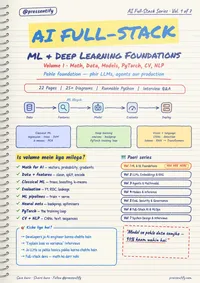
Volume 1 · 22 pages
ML & Deep Learning Foundations
Math, data, feature engineering, classical ML, metrics, neural networks, PyTorch, computer vision and NLP.
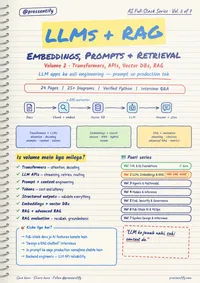
Volume 2 · 24 pages
LLMs, Embeddings & RAG
Transformers, LLM APIs, prompt and context engineering, structured outputs, embeddings, vector search and RAG end to end.
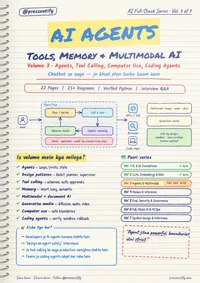
Volume 3 · 22 pages
Agents & Multimodal AI
Agent patterns, tool calling, memory, multimodal and document AI, generative media, computer use and coding agents.
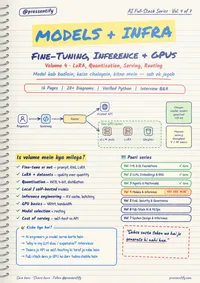
Volume 4 · 16 pages
Models, Inference & Infrastructure
Fine-tuning, LoRA, quantization, self-hosting, serving, GPUs, model selection and routing, and self-host vs API economics.
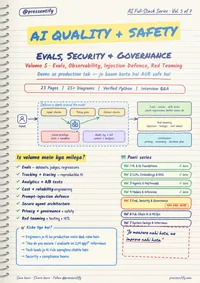
Volume 5 · 23 pages
Evaluation, Security & Governance
Evals, observability, cost engineering, prompt-injection defence, privacy, governance, red teaming and human-in-the-loop.
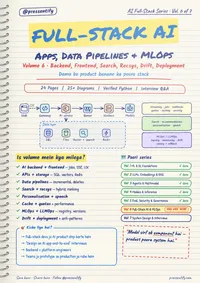
Volume 6 · 24 pages
Full-Stack AI Engineering & MLOps
AI backend and frontend, streaming, search and recommendations, speech, caching, MLOps, drift and reference architecture.
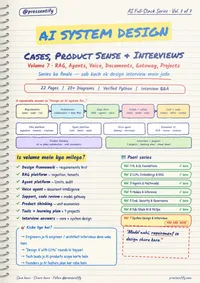
Volume 7 · 22 pages
AI System Design, Product & Interviews
An AI design framework, RAG, agent, voice and document cases, product thinking, seven projects and interview questions.
02What is inside
Every page, by topic.
146 page topics across 7 volumes, taken from the books' own page titles.
Vol 1 · ML & Deep Learning Foundations22 pages · 21 topics
- 01AI & ML Map
- 02Math I — Linear Algebra & Probability
- 03Math II — Calculus & Optimization
- 04Python for AI
- 05Data Fundamentals
- 06Feature Engineering
- 07Classical ML I
- 08Classical ML II
- 09Evaluation Metrics
- 10Validation & Generalization
- 11ML Pipelines
- 12Neural Networks
- 13Training Deep Nets
- 14PyTorch I
- 15PyTorch II
- 16Computer Vision I
- 17Computer Vision II
- 18NLP I — Text to Vectors
- 19NLP II — Sequences & Extraction
- 20Interview Bank
- 21Vol 1 Cheat Sheet
Vol 2 · LLMs, Embeddings & RAG24 pages · 23 topics
- 01Transformers I — Attention
- 02Transformers II — Architecture
- 03LLM Fundamentals
- 04LLM Behaviour & Reliability
- 05LLM APIs I — Basics & Streaming
- 06LLM APIs II — Reliability & Routing
- 07Prompt Engineering I
- 08Prompt Engineering II
- 09Context Engineering
- 10Tokens & Token Economics
- 11Structured Outputs
- 12Embeddings
- 13Vector Databases & ANN
- 14Hybrid Search & Reranking
- 15RAG I — The Pipeline
- 16RAG II — Ingestion & Chunking
- 17RAG III — Query-Time
- 18Advanced RAG I
- 19Advanced RAG II
- 20RAG Evaluation
- 21RAG Debugging Playbook
- 22Interview Bank
- 23Vol 2 Cheat Sheet
Vol 3 · Agents & Multimodal AI22 pages · 21 topics
- 01What Is an Agent?
- 02Agent Control & Safety
- 03Agent Patterns I
- 04Agent Patterns II
- 05Tool Calling I
- 06Tool Calling II
- 07Agent Memory I
- 08Agent Memory II
- 09Multimodal AI I — Vision
- 10Multimodal AI II — Audio & Search
- 11Document AI I — Parsing
- 12Document AI II — Extraction
- 13Generative Media I — Images
- 14Generative Media II — Audio, Video & Provenance
- 15Computer Use I — Browsing & Automation
- 16Computer Use II — Safe Boundaries
- 17AI Code Generation
- 18Software Engineering Agents I
- 19Software Engineering Agents II
- 20Interview Bank
- 21Vol 3 Cheat Sheet
Vol 4 · Models, Inference & Infrastructure16 pages · 15 topics
- 01Fine-Tuning: When & Data
- 02PEFT & LoRA
- 03Quantization & Compression
- 04Local & Self-Hosted Models
- 05Serving Architecture
- 06Inference I — Latency
- 07Inference II — Throughput
- 08GPU Fundamentals
- 09AI Infrastructure
- 10AI Model Selection
- 11AI Model Routing
- 12Self-Host vs API Economics
- 13Performance Playbook
- 14Interview Bank
- 15Vol 4 Cheat Sheet
Vol 5 · Evaluation, Security & Governance23 pages · 22 topics
- 01Evaluation I — Datasets & Scorers
- 02Evaluation II — Judges & Rubrics
- 03Regression Suites & EDD
- 04Experiment Tracking
- 05AI Observability & Tracing
- 06AI Product Analytics
- 07AI A/B Testing
- 08AI Cost Engineering
- 09AI Reliability Patterns
- 10AI Security Fundamentals
- 11Prompt-Injection Defence
- 12Secure Agent Architecture
- 13AI + Payments / High-Impact
- 14AI Supply Chain Security
- 15AI Privacy
- 16AI Governance & Compliance
- 17AI Safety & Responsible Development
- 18AI Red Teaming
- 19AI Testing Strategy
- 20Human-in-the-Loop
- 21Interview Bank
- 22Vol 5 Cheat Sheet
Vol 6 · Full-Stack AI Engineering & MLOps24 pages · 23 topics
- 01AI Backend Architecture
- 02AI Frontend
- 03AI UX Design
- 04AI APIs & Streaming Protocols
- 05AI Databases & Storage
- 06AI Data Pipelines
- 07AI Search Systems
- 08Search Relevance & Analytics
- 09Recommendation Systems I
- 10Recommendation Systems II
- 11AI Personalization
- 12Speech AI
- 13AI Performance & Caching
- 14Rate Limits & Quotas
- 15MLOps Fundamentals
- 16LLMOps & Versioning
- 17Model Monitoring
- 18Data & Model Drift
- 19Deployment Strategies for AI
- 20AI Architecture Anti-Patterns
- 21Reference Architecture
- 22Interview Bank
- 23Vol 6 Cheat Sheet
Vol 7 · AI System Design, Product & Interviews22 pages · 21 topics
- 01AI System Design Framework
- 02Case: Knowledge RAG Platform I
- 03Case: Knowledge RAG Platform II
- 04Case: Agent Platform I
- 05Case: Agent Platform II
- 06Case: Voice Agent I
- 07Case: Voice Agent II
- 08Case: Document Intelligence I
- 09Case: Document Intelligence II
- 10Case: Customer-Support Agent
- 11Case: Code-Review Assistant
- 12Case: Model Gateway
- 13AI Product Thinking I
- 14AI Product Thinking II
- 15AI Tools & Ecosystem
- 16Priorities & Learning Plan
- 17Seven Projects to Build
- 18Core Interview Questions
- 19System-Design Interview Questions
- 20Target Outcome
- 21Vol 7 Cheat Sheet
03Around it
Learn it, look it up, then keep the handbook.
The same subject is on the site as a course and a cheatsheet. The handbook is the printable version for revision.
- System Design HandbookHLD, LLD, case studies and interview prep, end to end — seven volumes, 170 pages.
- AWS Production HandbookRunning real workloads on AWS — one page per service, plus a second volume on EKS, events, identity, data and AI.
- Python HandbookPure Python from core language and OOP to internals, concurrency, data and AI — four volumes for freshers to 5-year engineers.
- FastAPI HandbookFrom ASGI and Pydantic to auth, async databases, queues, production and architecture — six volumes, 135 pages, every snippet run.
- Django HandbookDjango from request lifecycle to production architecture — ORM and PostgreSQL, auth and DRF, async and Celery, operations, design and interviews. Six volumes, 143 pages, every snippet executed.
?Questions
Before you start
- What exactly do I get?
- Access to the handbook in your library: every page, readable in the browser and printable as PDF. You pay once; there is no subscription.
- Can I read before I buy?
- Yes. Every volume has free sample pages. Sign in with a free account, open any volume, and the first pages are yours to read.
- Will I get updates?
- Yes. When a volume is revised, or a new volume is added to a handbook you own, it appears in your library at no cost.
- How do I pay?
- UPI, cards and netbanking through Razorpay. You enter an email; sign in with it to read.
- Refunds?
- Digital goods are not refundable once the full book is opened. If a file is broken or not as described, write to us within 7 days and we will fix it or refund you.
Read a few pages first.
Sample pages are free with an account.